The Em Dash—Why We All Need to Chill Out About It
Source: ChatGPT
I’ve said it before and I’ll say it again here—I was using the em dash WAY before it was controversial, and I’ll continue to use it until somebody pries it out of my cold, dead punctuation arsenal!
We writers live in a surreal world these days. Thanks to the technological paradigm shift we’ve experienced in the last few years, writers not only have to worry about being replaced by AI but are increasingly having their authentic work scrutinized by clients for any signs of AI use. This includes having our work analyzed by tools like ZeroGPT that allege to be able to detect the presence of AI-generated writing, which are entirely unreliable, regularly flagging handwritten content as written by AI and vice versa.
And then there’s the em dash. I never would have thought that this humble but tremendously versatile punctuation mark would become an object of controversy. And yet here we are at a point where ample use of this orthographic tool is enough to convince many editors and writing clients that you’re outsourcing your writing to an LLM.
Why AI Loves Em Dashes
So how did this humble punctuation mark become synonymous with ChatGPT and other AI tools? Simply put, AI loves it because AI is trained on high-quality writing, and English-language writers since at least the 17th century have loved the em dash. Some of the earliest printed works of Shakespeare use them. Jonathan Swift even describes their use in his 1733 work On Poetry:
Blot out, correct, insert, refine,
Enlarge, diminish, interline;
Be mindful, when Invention fails;
To scratch your Head, and bite your Nails.
Your poem finish'd, next your Care
Is needful, to transcribe it fair.
In modern Wit all printed Trash, is
Set off with num'rous Breaks⸺and Dashes—
Good writers have always liked it because of its immense versatility. It can be used in place of a colon or a set of parentheses. It is useful for demonstrating an abrupt change of thought in places where a period would be too strong and a comma not strong enough. It can also be used to denote interruption, either by oneself or another person, in place of an ellipsis, which suggests a drifting off of speech rather than an abrupt interruption.
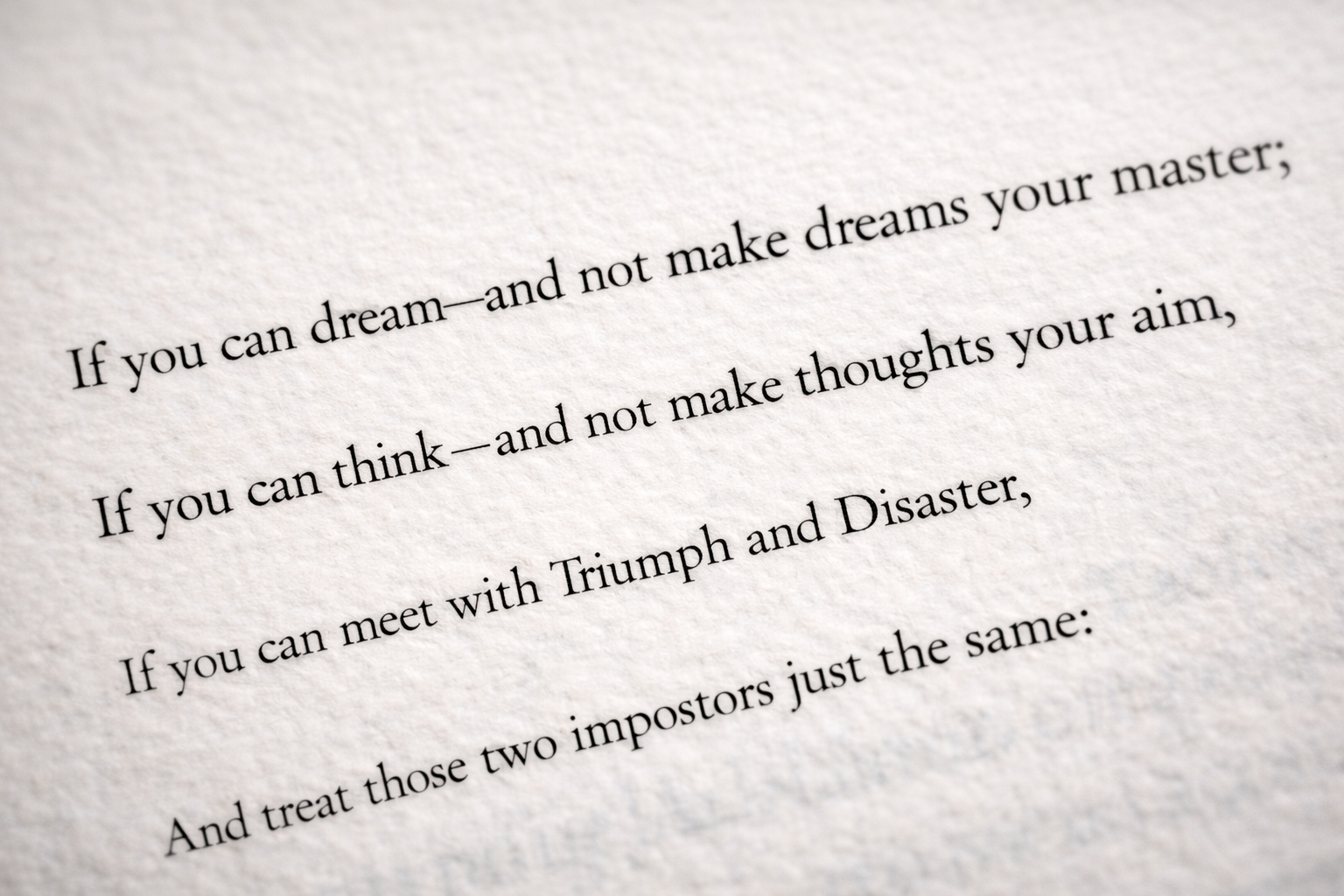
For a masterclass in em dash use—and strategic punctuation in general—one need look no further than Rudyard Kipling’s famous poem If—. (Yes, that’s an em dash in the title.) In it, the poet alternates between commas, semicolons, colons, the occasional exclamation mark, and em dashes, with em dashes used to denote breaks in thought within a single line. Here’s the poem with all its punctuation glory:
If you can keep your head when all about you
Are losing theirs and blaming it on you;
If you can trust yourself when all men doubt you,
But make allowance for their doubting too:
If you can wait and not be tired by waiting,
Or being lied about, don't deal in lies,
Or being hated don't give way to hating,
And yet don't look too good, nor talk too wise;
If you can dream—and not make dreams your master;
If you can think—and not make thoughts your aim,
If you can meet with Triumph and Disaster
And treat those two impostors just the same:
If you can bear to hear the truth you've spoken
Twisted by knaves to make a trap for fools,
Or watch the things you gave your life to, broken,
And stoop and build 'em up with worn-out tools;
If you can make one heap of all your winnings
And risk it on one turn of pitch-and-toss,
And lose, and start again at your beginnings
And never breathe a word about your loss:
If you can force your heart and nerve and sinew
To serve your turn long after they are gone,
And so hold on when there is nothing in you
Except the Will which says to them: 'Hold on!'
If you can talk with crowds and keep your virtue,
Or walk with Kings—nor lose the common touch,
If neither foes nor loving friends can hurt you,
If all men count with you, but none too much:
If you can fill the unforgiving minute
With sixty seconds' worth of distance run,
Yours is the Earth and everything that's in it,
And—which is more—you'll be a Man, my son!
As you can see, the humble em dash does a lot of heavy lifting in this poem, as it’s done for a lot of writers over the centuries. It’s little wonder, then, that our LLMs rely heavily on it. Our greatest writers have also done so.
How To Use It—And Not Sound Like AI
The em dash, it should be noted, does have its detractors. Because of its great versatility, it can become a crutch for writers, and, when overused, it does start to make writing feel disjointed. Notice in that last sentence I stuck to commas where I could have used em dashes before and after the words “when overused.” To my mind, an em dash signifies a change of thought, whereas the aforementioned sentence is a continuous thought with strategic pauses. Em dashes would have broken the flow.
One thing I’ve noticed about ChatGPT at least is that it seems to completely distain semicolons. Semicolons are another useful piece of punctuation, one that, to my mind at least, denotes a pause greater than that denoted by a comma but lacking the abruptness of an em dash or a period. Technically, it’s used to string two independent clauses together that are sufficiently interconnected to not warrant a period. To me, there’s something reassuring and relaxing about a semicolon, whereas the em dash can be a jarring interruption.
You’ll notice in the Kipling poem that semicolons are used as breaks between stanzas—places to take a breath—whereas em dashes are used for quick shifts in perspective in the form of juxtaposed statements like “If you can dream—and not make dreams your master.” This line doesn’t let you rest in the thought of dreams before admonishing you for wanting to live in a world of dreams, and for that sort of jarring juxtaposition, the em dash is the perfect tool.
For me, one of the telltale signs of AI writing is that it seldom makes for relaxing reading. From the single-sentence paragraphs to the bulleted lists (usually with unasked-for emojis) to the prevalence of em dashes, AI writing is, by design, to the point, easy to digest, and scannable but also, by default, ends up lacking any of the soft contours of human-generated writing. The ubiquitous em dashes aren’t helpful on this front. Sure, they’re grammatically correct, but when used as the default punctuation, they feel like driving a car through potholes.
Any time I use AI to generate a first draft of something, I tend to do two things first. First, I condense paragraphs wherever appropriate. Sure, single-sentence paragraphs serve a purpose when used sparingly, but paragraphs serve the purpose of grouping a thought or theme together, and I myself like to be able to settle into a paragraph for a little while. The other thing I do is go over the punctuation, and I invariably end up changing some of the em dashes into semicolons or commas wherever the dashes feel disjointed. It’s not about disguising AI writing as my own; it’s about softening edges where softening is appropriate.
That said, rules are there to be broken and I’m not going to tell anyone how they should use punctuation. After all, Hubert Selby Jr., one of my all-time favourite writers, spent an entire career using forward slashes instead of apostrophes, giving his already jarring writing an even more unsettling feel. I say you do you—just own it!
Em vs En Dashes—What’s the Difference?
The em dash, as you may well know, is called the em dash because its length is equivalent to the letter M in print. There is a shorter dash, between an em dash and a hyphen in length, called an en dash, which, no surprise, is the length of the letter N. There also exist more exotic forms of dashes, such as the really long one used by Jonathan Swift in his reference to “Breaks⸺and Dashes—,” but these are rarely seen and I know no specific rules around their use.
Whereas the em dash is used in a variety of circumstances, the en dash is used in a narrower set of instances, either to indicate ranges (e.g., “pages 10–20”) or connections between words in compound adjectives (e.g., “New York–London flight”). En dashes are perhaps the most frequently misused (or rather underutilized) punctuation mark, with most people opting for hyphens where an en dash is called for. A lot of people also put spaces before and after en dashes (as well as em dashes), something most style guides tell you not to do.
But again, I’m not in the business of telling people what to do with their punctuation. And the older and more experienced I get, the less I take it personally whether people, say, use the Oxford comma or not. I’m just in the business of helping clients look and sound smarter, and effective and consistent punctuation use, while subtle, goes a long way in that direction.
Same goes with the em dash. We all need to chill out about it. ChatGPT will eventually evolve out of its current obsession with them, and it will go back to being just another punctuation mark in writers’ arsenal. In the meantime, we just need to edit AI-generated content with an eye for detail—and a healthy dose of human feel—to purge it of its AI quirks. And acknowledge where AI-generated em dashes are in fact called for. Sometimes the machine is right.
If you’re struggling with your content—and concerned about keeping things human—I would love to support you. Whether it’s ghostwriting blog posts or LinkedIn content or developing email funnels or marketing pages, I’d love to be your content guy. Contact me here and let’s talk em dashes and more!